

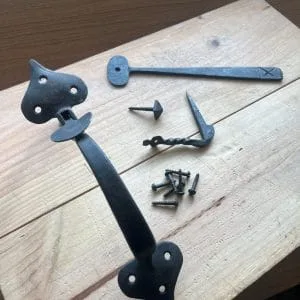
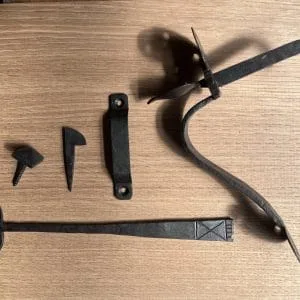
HL Hinges, Small(Pair)
£23.04 Excl. VAT
Out of stock
Description
Forged HL hinges are a beautiful blend of craftsmanship and functionality, often used on traditional doors, cabinets, and gates. Here’s how they’re typically made using traditional blacksmithing techniques:
What Are HL Hinges?
- Shape: The “H” part mounts vertically, while the “L” arm extends horizontally across the door or frame.
- Purpose: Offers strong support and a decorative touch, especially for ledge & brace doors or period-style furniture.
- Material: Forged from mild steel.
How They’re Made (Hand-Forged Process)
- Heating the Metal
- A bar of mild steel is heated in a forge until it’s red-hot and malleable.
- Drawing Out the Shape
- The blacksmith uses a hammer and anvil to shape the metal into the HL profile.
- The “H” and “L” sections are formed by tapering and bending the hot metal.
- Punching Screw Holes
- While still hot, holes are punched using a drift or drill for mounting screws.
- Forming the Hinge Barrel
- A cylindrical barrel is forged and wrapped around a mandrel.
- A pin is inserted to allow rotational movement between the plates.
- Finishing Touches
- Edges are cleaned and smoothed.
- A beeswax coating or black powder finish is applied for rust protection and a traditional look.
Why Forged Hinges Are Special
- No two are identical—each hinge is a unique piece of functional art.
- Durability: Forged hinges last for decades, even centuries.
- Aesthetic: Adds character and authenticity to period-style architecture.
Additional information
| Weight | 1 kg |
|---|---|
| Dimensions | 10 × 10 × 5 cm |
Only logged in customers who have purchased this product may leave a review.
Reviews
There are no reviews yet.