
Menu
Old House Store offers a range of traditional lime mortars, perfect for block laying, bricklaying, stonemasonry, pointing, plastering, and rendering. We also offer hydraulic and non-hydraulic lime mortars, ideal for heritage restoration and eco-friendly projects. Additionally, our lime-based products are known for their breathability, which helps prevent damp and decay in historic buildings. With detailed product specifications, expert advice, and reliable delivery options, Old House Store ensures you find the right lime mortar for your needs.
Additionally, we offer a range of limestone mortars with differing coarseness to

suit different requirements. These are made using industry leading hot mixing techniques that replicate the traditional methodology of stonemasons over the centuries. These range between an ultra fine ready to use mix of 1 part silver sand and 1 part non-hydraulic lime that is used as a finish coat plaster through to our coarse option, a ready to use mix of 3 parts sharp sands and 1-part non-hydraulic lime which is used more as a base coat plaster, render or mortar.
Delivery is calculated at checkout and details will vary depending on the size of your order, product type and availability of products.
If you have any questions before making an order, please contact us on 0118 946 9146 or email us at [email protected] and we will respond at our earliest opportunity.
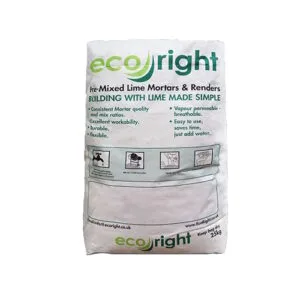

Lime mortar is a type of building material that has been used for centuries in the construction of buildings and structures. It is made from a mixture of lime, sand and water, and is used to bond together bricks, stones and other building materials.
Lime mortar is a versatile material that is valued for its durability, flexibility and breathability. It allows buildings to “breathe” by enabling moisture to evaporate, which helps prevent moisture build-up and damage. This makes it ideal for use in historic buildings and other structures that require a breathable building material. If you'd like a more detailed explanation, click here.
Non-hydraulic lime mortar is a type of lime mortar that is made solely from lime putty and sand, without any added hydraulic or pozzolanic additives. It is also known as “pure” lime mortar or “fat” lime mortar.
Unlike hydraulic lime mortar, which sets and hardens through a process of hydraulic curing, non-hydraulic lime mortar hardens through a process called carbonation. Carbonation is a slow process that occurs when the lime mortar is exposed to carbon dioxide in the air, which causes the lime to absorb carbon dioxide and harden over time. If you'd like a more detailed explanation, click here.
Hydraulic lime mortar is a type of lime mortar that is made from a combination of lime, sand and hydraulic or pozzolanic additives. It is also known as “hydraulic” lime mortar or “semi-hydraulic” lime mortar.
Unlike non-hydraulic lime mortar, which hardens through a process of carbonation, hydraulic lime mortar sets and hardens through a process of hydraulic curing. This means that it sets and hardens when it comes into contact with water, rather than through exposure to air. If you'd like a more detailed explanation, click here.
Coverage depends on joint size and brick/block dimensions, but as a rough guide, a 25kg bag of lime mortar will cover about 2.5 – 2.8 m2 of brickwork with 10mm joints. Always check the specific product data for accuracy.
Lime mortar typically cures over several weeks. While it sets within a few days, full carbonation (the process that hardens it) can take several months, depending on temperature, humidity, and exposure to air. It remains workable longer than cement, allowing for adjustments during application.
It’s not recommended. Lime mortar should be applied in temperatures above 5°C and protected from frost and heavy rain for at least a week. Excess moisture or freezing conditions can weaken the bond and affect curing.
Yes. Lime mortars can be colour-matched by adjusting the type and blend of sands or by adding natural pigments. This is especially useful for conservation work where visual continuity with historic masonry is important.
Yes, lime mortar is versatile and can be used for pointing, internal plastering, and external rendering. The mix may vary slightly for each use, so ensure you're using the appropriate grade for the job.
sign up today
By submitting this form you agree for us to send latest deals and product updates in accordance with our Privacy policy.